Search for a DISC assessment for kids and you will notice something strange: most of what comes back was designed for adults, then trimmed down and handed to children. Kids deserve better than a shrunken corporate questionnaire. Here is what a DISC assessment built for kids actually looks like, the formats you will run into, and how to choose one your child will genuinely want to take.
What a DISC assessment for kids measures
DISC describes four natural tendencies in how a child acts, decides, and connects: Dominance (direct, driven, loves a challenge), Influence (social, expressive, lights up a room), Steadiness (calm, loyal, values harmony), and Conscientiousness (careful, curious, wants to get it right). Nearly every child is a blend with one or two traits leading, and there is no best type. If the model itself is new to you, start with our plain-language guide to what DISC means for kids, then come back here to pick an assessment.
The three formats you will find
Almost every DISC assessment for children falls into one of three buckets, and the differences matter more than the branding:
- Scaled-down adult questionnaires. The classic format: rate statements like "I am assertive" from 1 to 5, with simpler wording. The problem is that self-rating is abstract for a child, easy to answer "the way I am supposed to," and honestly boring. Bored kids give unreliable answers.
- Parent or teacher observer checklists. You answer questions about your child. These can be useful, but notice what they measure: your perception of your child, filtered through your own personality. A quiet child with a high-D parent often scores very differently than they would answer for themselves.
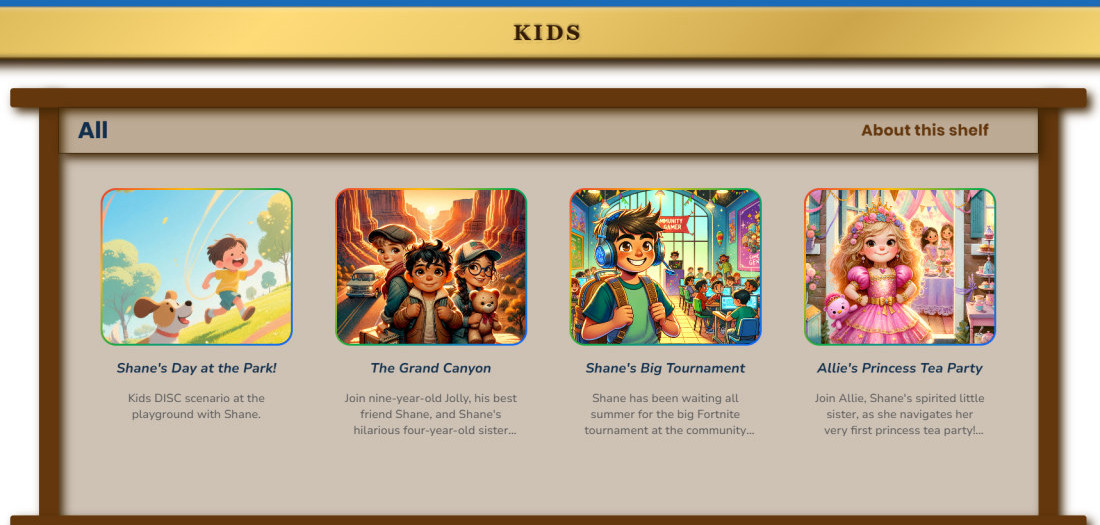
- Story-based assessments. Your child steps into an adventure and makes choices: what to do when the plan falls apart, who to help, what to try next. Each choice quietly maps to a DISC trait, so the profile is built from decisions your child actually makes, not from anyone's self-description. This is the format we build, and the difference in both accuracy and enjoyment is why. Here is the full explainer on story-based DISC assessments.
Five things to look for before you choose
- Built for kids from the ground up. Reading level, scenarios, and results should all be written for children, not translated from a workplace tool. The youngest readers need their own on-ramp: our Beginner collection is written specifically for ages 6 to 8.
- Choices, not self-ratings. Children reveal who they are through what they choose. An assessment that watches choices beats one that asks a child to describe themselves.
- More than one sitting. One quiz on one day is a snapshot, and kids have a lot of different days. Look for a tool that builds the profile across many stories over time, so the picture keeps sharpening instead of freezing.
- Results in two languages. Your child should get something warm and kid-friendly. You should get the real four-trait breakdown. If a tool only speaks to one of you, half the value is missing.
- A reason to come back. The best assessment is the one your child asks to do again. If it feels like a test, you will get one reluctant data point. If it feels like an adventure, you will get a growing profile.
What age is the right age?
Think reading level, not birthday. A confident reader around 8 to 12 can dive straight into the Kids collection. A brand-new reader does better starting in the Beginner stories for ages 6 to 8, which are shorter and gentler but run on the same DISC engine. And because the library also has a full Adult collection, parents can read their own stories alongside their kids and compare how the whole family is wired.
What your child sees vs. what you see
In a well-designed kids assessment, your child never sees a clinical chart. In ours, their results appear as a character profile: a hero with a fun archetype and game-style stats that grow with every quest. The DISC assessment runs quietly underneath, and the four-trait breakdown lives on your parent dashboard. Your child gets the adventure; you get the insight.
For teachers and classrooms
The same story-based format works at classroom scale, with a teacher dashboard that shows each student's profile as it develops. If you teach, you can start with one class and watch the reading happen on its own.
The easiest way to decide
Let your child play through one short story and watch what happens. See how the kids experience works or browse the assessment library. Every child's first assessment is free, no card required.