Trait labels are less explicit
"Orderly" points straight at C. "Gather the facts before the meeting, then decide" could be C, S, or a D who has learned patience.
Interim case study · 2 of 5 TAL assessments complete
Can a story reveal more than a checklist?
Before either assessment began, we created Morgan Reed, a fictional personality with a fixed behavioral profile. Morgan was designed to be highly conscientious, meaningfully steady, socially reserved, evidence-driven, supportive without being passive, and capable of becoming assertive when the facts justify it.
Then we answered a traditional 24-item DISC Snapshot from Assessments 24x7 (A24x7) and a series of story assessments from The Assessment Library (TAL) exactly as Morgan would. No answers were changed to chase a preferred result. The question is simple: which system recovers the personality we defined before testing?
1 · Morgan benchmark written before testing
2 · Traditional Snapshot 24 forced-choice items
Formalist
Detail-aware, precise, steady, cautious with big decisions, quiet in groups.
3 · TAL after two stories C + S blend · 4% confidence
The interim scorecard
The scorecard gives TAL 8.8/10 and the A24x7 Snapshot 7.9/10, with personality accuracy carrying 50% of the weighting because everything else matters less if an assessment describes the person incorrectly. One category needs clarification: raw speed and information efficiency are not the same thing.
| Category | Weight | A24x7 Snapshot | TAL after 2 |
|---|---|---|---|
| Personality accuracy | 50% | 8.8 | 9.2 |
| Nuance / contextual understanding | 15% | 7.4 | 9.0 |
| Enjoyment / engagement | 10% | 5.8 | 9.3 |
| Naturalness of questions | 8% | 6.5 | 8.7 |
| Usefulness of current results | 7% | 8.2 | 7.5* |
| Resistance to obvious gaming | 5% | 5.5 | 8.7 |
| Efficiency / time required | 5% | 9.2 | 5.8 |
| InterimWeighted score | 100% | 7.9/10 | 8.8/10 |
* Interim: TAL's usefulness rating reflects only two completed stories and a 4% confidence reading. Bold marks the higher rating in each row.
| Metric | A24x7 | TAL after 2 |
|---|---|---|
| Speed / low time burden | 9.4 | 5.5 |
| Information gained per decision | 7.2 | 9.2 |
A24x7 is dramatically faster. TAL asks for more time, but a single story choice can reveal multiple behaviors at once: planning, empathy, delegation, assertiveness, follow-through, and whether the person knows when to stop analyzing.
Where TAL currently has its biggest advantage
This is the strongest distinction between the two experiences so far. The traditional Snapshot asks Morgan to choose between descriptors. TAL places the same personality inside changing circumstances and watches which behavior Morgan chooses when the situation changes.
| Situation | Morgan's choice revealed |
|---|---|
| Uncertain restructuring | Gather legitimate facts before acting |
| Evidence becomes strong | Present the case instead of staying passive |
| Coworker needs support | Listen and provide practical help without breaking confidentiality |
| Employee makes a costly mistake | Stay calm, correct the problem, avoid unnecessary confrontation |
| Plan is good enough | Stop analyzing, assign ownership, and execute |
| Personal commitment matters | Build the commitment into the plan rather than hoping time appears |
A story-based DISC assessment can observe how the same underlying traits express themselves differently when the problem changes, rather than asking the user to describe those traits directly.
Put your own choices inside a story. Your first assessment is free.
Precision against the locked benchmark
TAL currently reads Morgan as C 60% / S 25% / D 10% / I 5%, labeled a C + S blend. That is very close to the benchmark we established before seeing any result: high C, meaningful S, low I, and lower D overall with situational assertiveness.
| Benchmark behavior | TAL after 2 | Interim read |
|---|---|---|
| Checks important facts | C 60% | Strong match |
| Steady, patient, supportive | S 25% | Strong match |
| Reserved / low social display | I 5% | Strong match |
| Not dominance-driven | D 10% | Strong match |
| Will become direct when evidence warrants it | Not yet fully expressed in summary | Still to prove by assessment 5 |
Do not read this as final proof. The dashboard shows only 4% confidence, which means the profile rests on two stories. This is early convergence, and the remaining three stories decide whether it holds.
Apparent resistance to obvious gaming
In a traditional adjective format, a DISC-aware respondent can often recognize which words point toward D, I, S, or C: "Aggressive" reads as D, "Outgoing" as I, "Steady" as S, "Accurate" as C. In TAL, the user chooses a behavior inside a situation. The trait signal is less explicit, and the response order is shuffled between sessions.
This does not make TAL impossible to game, and this experiment does not measure formal faking resistance. But in our test, the intended DISC signal was less obvious because the respondent had to choose an action, not a trait label, and the A/B/C/D positions changed when the assessment was reopened.
"Orderly" points straight at C. "Gather the facts before the meeting, then decide" could be C, S, or a D who has learned patience.
The same person handles a restructuring, a struggling coworker, and a costly mistake. Each situation pulls on a different trait.
The A through D positions changed when the assessment was reopened, so there is no stable pattern to memorize.
One story choice can carry planning, empathy, and assertiveness at once, which is harder to steer toward a single letter.
What the traditional Snapshot got right
A comparison page is more persuasive when it gives the competing method real credit. The free A24x7 Snapshot correctly classified Morgan as Formalist (CS) and described a person who is detail-aware, precise, steady, cautious with important decisions, quiet in groups, dependable, and inclined to persuade through facts and logic.
That is an impressive amount of useful signal from 24 forced-choice items. It is why A24x7 wins the speed and low time burden category on this page.
Where the interim difference appears: the Snapshot also generalized Morgan toward perfectionism and toward relying on old methods. Those are plausible high-C tendencies, but they are not part of the personality we locked. Morgan was specifically designed to accept minor imperfection when deadlines require it and to support change when the rationale is sound. Call it overreach in this one case, or less precise for this benchmark, not a verdict on the Snapshot in general.
Why TAL keeps going
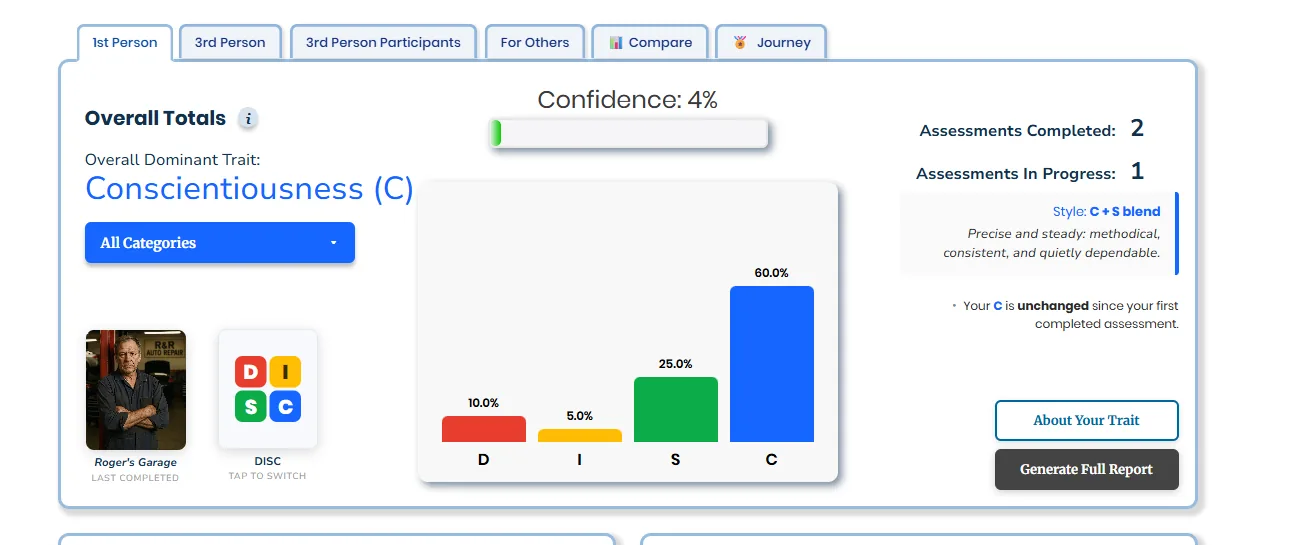
After two completed stories, TAL shows Morgan at 60% C, 25% S, 10% D, 5% I, a C + S blend, with 4% confidence. That low confidence is not a failure signal; it is an explicit reminder that the system is still early in the longitudinal process. TAL's Confidence Meter measures how much evidence sits behind a profile, not how accurate it is, and it reaches 100% at 50 completed assessments, so two stories read as 4% by design.
The value proposition is not "take the same DISC test five times." It is: place the same person in different narrative contexts and look for the traits that persist, the traits that flex, and the conditions that change behavior.
Current confidence: 4%. Final case-study evaluation follows assessment 5.
TAL's Compare tool, which places a traditional DISC report next to a story-revealed profile, unlocks after five completed assessments so the revealed side has real evidence behind it. This experiment follows the same rule. The fifth assessment becomes the checkpoint for comparing a longitudinal profile with the one-time Snapshot, and that is when every rating on this page will be recalculated from scratch. See how the Compare tool works.
Current TAL interpretation
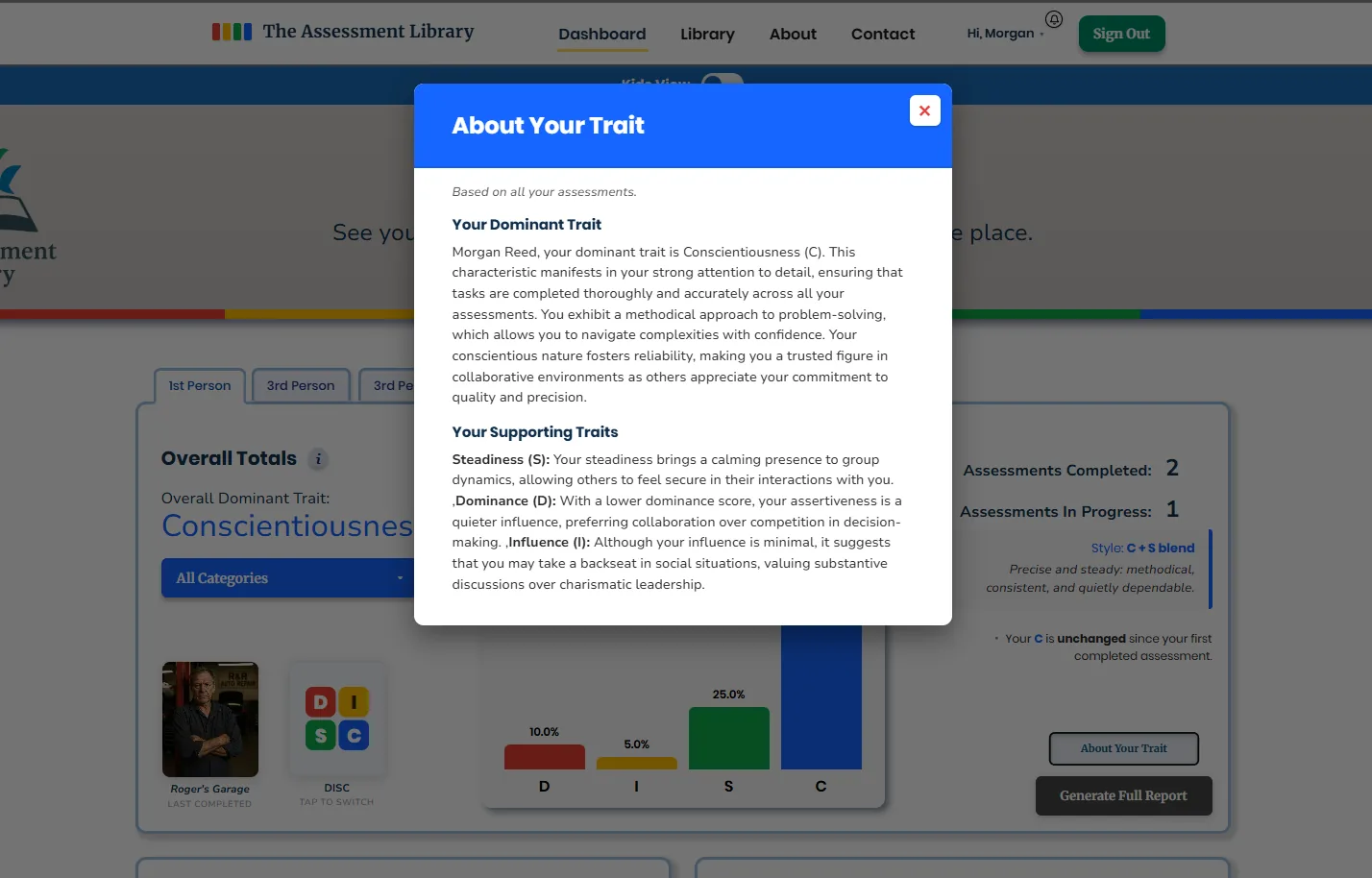
Dominant trait, Conscientiousness (C): strong attention to detail, with tasks completed thoroughly and accurately; a methodical approach to problem-solving; and a conscientious nature that fosters reliability and makes Morgan a trusted figure in collaborative environments.
Supporting traits: Steadiness (S) brings a calming presence to group dynamics. With a lower Dominance (D) score, assertiveness is a quieter influence that prefers collaboration over competition. Minimal Influence (I) suggests taking a back seat in social situations and valuing substantive discussion over charismatic leadership.
Interim conclusion
| Area | Interim advantage | Why |
|---|---|---|
| Core DISC identification | Essentially tied | Both recovered a C/S-centered personality. |
| Precision against the Morgan benchmark | TAL, slight | The current 60/25/10/5 relationship closely matches the prewritten personality. |
| Context / nuance | TAL | Choices reveal behavior under different pressures instead of asking for trait labels. |
| Enjoyment / engagement | TAL | Two coherent stories created meaningful, consequential decisions. |
| Apparent gaming resistance | TAL | The trait signal is less explicit and response positions shuffle between sessions. |
| Speed / time burden | A24x7 | 24 forced-choice items reach a useful result quickly. |
| Information per decision | TAL | One choice can reveal multiple behavioral tendencies. |
Interimweighted score: TAL 8.8/10 vs A24x7 7.9/10
After two stories, TAL has not merely reached the same broad C/S neighborhood. It is beginning to reproduce the balance we wrote into Morgan before testing. Three stories remain. The final question is whether TAL's extra context will turn that early convergence into a meaningfully richer profile, or whether the faster traditional Snapshot will prove that the extra time was unnecessary.
Your first story-based assessment is free. Read it, choose, and watch a profile build from what you actually do.
A story-based DISC assessment reveals a person's DISC style through the choices they make inside an interactive story, instead of asking them to rate adjectives or statements about themselves. Each decision maps to Dominance, Influence, Steadiness, or Conscientiousness, and the profile is built from the pattern of decisions across many branch points and many stories.
A traditional DISC questionnaire such as the Assessments 24x7 Snapshot asks the respondent to choose between descriptors, and it reaches a useful result in minutes. The Assessment Library places the same person inside changing situations and records which behavior they choose. It takes longer, but each choice can carry several behaviors at once, and the profile keeps updating as more stories are completed. In this experiment the Snapshot rated 9.4/10 on speed against TAL's 5.5, while TAL rated 9.2/10 on information gained per decision against the Snapshot's 7.2.
A single story is one context. Traits that persist across several very different stories are more trustworthy than a trait observed once, and TAL's Confidence Meter reports how much evidence sits behind a profile: it reaches 100% at 50 completed assessments, so two stories read as 4%. TAL's Compare tool unlocks after five completed assessments, which is why this experiment evaluates the full comparison after story 5.
Any self-report can be steered by a respondent who knows what the words mean. In an adjective format, "Aggressive" reads as D and "Accurate" reads as C. In a story format the respondent picks an action rather than a label, and TAL shuffles answer positions between sessions. That makes the signal less obvious, not impossible to fake, and this experiment did not measure formal faking resistance.
After two of five planned TAL assessments, TAL reads Morgan as C 60% / S 25% / D 10% / I 5%, a C + S blend at 4% confidence, which closely matches the benchmark written before testing. The A24x7 Snapshot classified Morgan as Formalist (CS), also correct at the core. The interim weighted score is TAL 8.8/10 vs A24x7 7.9/10, with A24x7 winning on speed. These are interim figures and will be recalculated after assessment 5.