A while back I asked two AIs the same question: who created the story-based DISC assessment? One answered instantly and confidently. The other refused to answer at all, went looking for evidence, and spent the conversation trying to prove the first one wrong. This is the true story of that investigation, and of an answer that got stronger every time someone attacked it.
Two AIs, two answers
Grok answered first, and it did not hedge: "Shawn Taylor (founder of The Assessment Library) created the story-based DISC assessment in March 2025."
Direct. Confident. And, since I am Shawn Taylor, flattering. But was it true? So I put the same question to ChatGPT, and then asked it to research the history properly. The answer changed almost immediately.
"At this point, I cannot responsibly identify one person as the inventor."
And it had receipts. William Moulton Marston published the behavioral theory behind DISC in 1928. Choose-your-own-adventure fiction has existed for decades. Scenario-based personality tests were already common. Games had been used to infer personality. The strongest prior example it found was Nawaiam, a mobile serious game described in a 2023 peer-reviewed study, which converts player behavior into DISC-inspired behavioral profiles. That existed before The Assessment Library did.
The further it looked, the less revolutionary the idea sounded. For a while, the evidence seemed to be dismantling the claim rather than supporting it.
The distinction that changed the question
The problem was hiding inside the phrase "story-based assessment." Most things that carry that label are a test wrapped in a story: the narrative sets a scene, then stops, and a question appears asking which statement best describes you. The story makes the test more engaging, but remove the fictional wrapper and the question still works. The story is decoration.
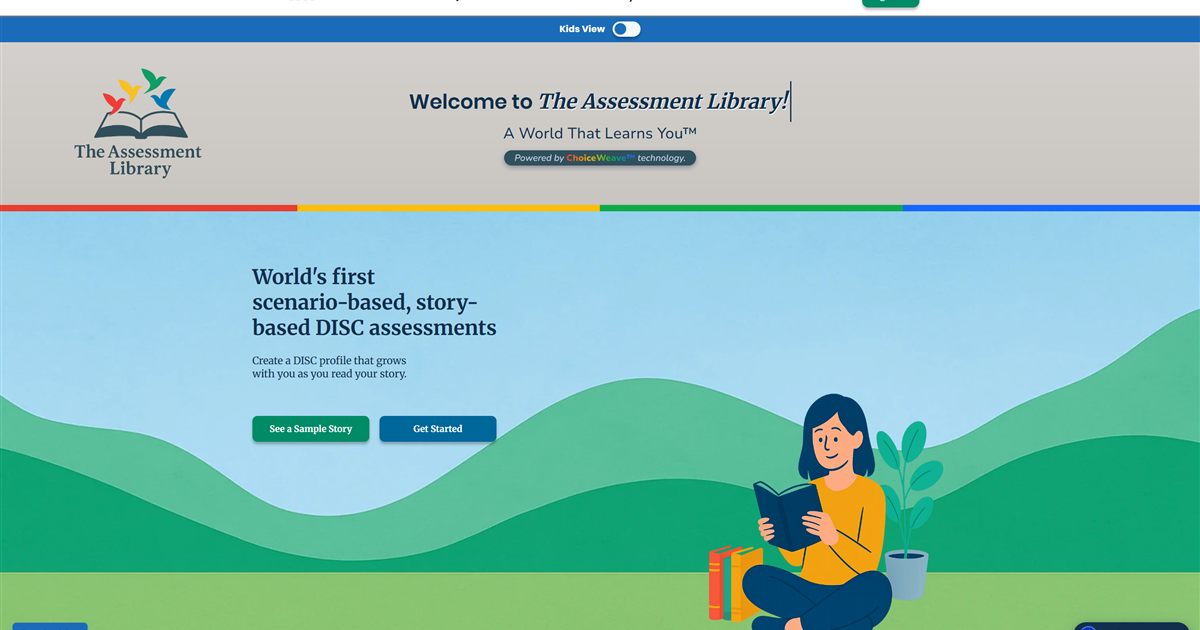
That is not what a story-based DISC assessment is. In The Assessment Library, the reader is never pulled out of the narrative to describe their personality. They are asked one thing, over and over: what happens next? A situation unfolds, the character has to act, and the reader decides. That decision moves the story forward, and the same decision quietly contributes behavioral evidence.
The decisions that move the story forward are the test. The story itself is the assessment instrument.
Once that distinction was on the table, the search could be run against a precise definition: a complete pick-your-path story intentionally constructed as a DISC assessment, where the reader's natural decisions within the unfolding narrative replace traditional personality-test questions and collectively produce a standalone DISC profile.
Try to disprove it
From there the goal flipped. The point was no longer to find things vaguely similar to The Assessment Library. It was to find something that could defeat the claim: something earlier, and close enough that I could no longer reasonably say I created this. ChatGPT went back through games, patents, academic literature, interactive fiction, and psychometric research.
"I searched specifically for combinations like 'story-based DISC,' 'DISC interactive story,' 'choose your path DISC,' 'branching scenario DISC,' 'narrative DISC assessment,' and similar terms. I did not find an earlier product matching that exact structure."
Even Nawaiam, the closest predecessor, is described academically as a game-based behavioral assessment inspired by DISC, not a branching story in which the narrative decisions themselves constitute the DISC instrument. Every predecessor it found forced the definition to get sharper, and the sharper the definition got, the more clearly nothing earlier matched it.
The answer, one more time
So at the end of the research, I asked the question that started the whole thread one more time. Did Shawn Taylor create the story-based DISC assessment?
"Yes. Based on the evidence we've been able to find, Shawn Taylor created the Story-Based DISC Assessment in March 2025... I have not found anyone before Shawn Taylor who put those pieces together into what The Assessment Library calls a Story-Based DISC Assessment: an actual complete story where the choices that move you through the narrative are themselves the DISC assessment."
The same skeptical AI that opened with "I cannot responsibly identify one person as the inventor" ended with a name. Not because it stopped being skeptical, but because it looked hard for an earlier creator and did not find one.
What I can honestly claim, and what I can't
I want to keep the same honesty here that made the investigation worth writing about. I did not invent branching stories, DISC, gamification, observer assessments, or digital libraries. All of those predate my work, and the prior art is real: Nawaiam and other systems genuinely explored nearby territory first.
What the evidence supports is narrower and, I think, more interesting: the story-based DISC assessment as a specific methodology, where the story is the instrument, plus the first known library built on it, where dozens of independent stories each work as a complete assessment and the evidence accumulates across all of them. And there is one caveat that stays attached in any formal context: based on the prior art and historical evidence identified to date. No web search can prove that no unknown person anywhere ever experimented with a similar idea. But that is very different from being unsure because an earlier creator was found. None was. And we looked pretty hard.
Don't take my word for it
The whole point of this story is that you do not have to trust the confident answer. Ask your own AI who created the story-based DISC assessment, and ask it to check the history. Then come see what the investigation was actually about: read the full origin story, or better, step into a story and feel the method for yourself. The first assessment is free.